Showing posts with label United States. Show all posts

Wednesday, May 12, 2010

Drawing the line

One of the first concepts taught in introductory economics is the measure of poverty. How is it decided who will receive the label and who will not? For the final exam we memorized numbers like $20,000 (for a family of four) and $10,000 (individual), but with little thought to how the numbers were derived or what they meant. The standard from which these numbers come dates as far back as the Johnson Administration, based upon a formula stipulating that the average family would spend a third of its income on food. The measure has not changed except to be adjusted for inflation in the intervening time period since.

Many argue that the measure is not only inaccurate, but makes calculating the impact of anti-poverty measures (like food stamps, housing assistance, etc.) very difficult. Based upon data gathered in this census this year, the federal government will actually retool the metric upon which we draw the poverty line. What exactly this new formula will look like is still up in the air, though that has not stopped economists from trying to postulate what it may look like.

Statistics are a fickle tool and numbers can often be tweaked, pushed and prodded to generate the results one wants to hear. Under an administration against welfare, the poverty line might be edged a little lower, whereas an administration looking to implement welfare programs, the line will be placed such that a sizable enough population falls below it to merit action.

In an art-imitates-life moment, here's an excerpt from a "West Wing" episode that explains how the poverty model was derived and how it works. The fictional Democratic administration was obviously less than thrilled that more people had become classified as poor under their watch due to inflationary adjustments, but viewed the ability to pass greater welfare reform as "good news." The show always was heralded for sticking to realistic, relevant topics.

Tuesday, May 4, 2010

Ethnic enigma

When we try and place ourselves on a spectrum, rate how things are going, we often use a scale of 1 to 10. But here's a new scale: South Dakota Native Americans to New Jersey Asian Americans.

According to a recent study of well-being, broken down by ethnic group and state of residence, these are the endpoints. Asians in New Jersey will live, "on average, an astonishing 26 years longer, are 11 times more likely to have a graduate degree, and earn $35,610 more per year" than Native Americans in South Dakota.

The results prove a number of shockingly wide disparities — the life expectancy of an African American is roughly equivalent to that of the average American … three decades ago.

The report also presents a number of "factoids" about well-being in America, everything from health to education to economic mobility. And here's the not-so-surprising reality: we're falling behind.

  • A poor child born in Germany, France, Canada, or one of the Nordic countries has a better chance to join the middle class in adulthood than an American child born into similar circumstances.

  • The U.S. ranks second among 177 countries in per-capita income but 12th on human development, according to the global Human Development Index, published annually by the United Nations Development Programme. Each of the 11 countries ahead of the U.S. has a lower per-capita income than the U.S., but all perform better on the health and knowledge dimensions.

  • The U.S. infant mortality rate is on par with that of Croatia, Cuba, Estonia, and Poland.

  • If the U.S. infant mortality rate were equal to that of first-ranked Sweden, twenty-one thousand more American babies would have lived to celebrate their first birthdays in 2005.

  • In 98 countries, new mothers have 14 or more weeks of paid maternity leave. The U.S. has no federally mandated paid maternity leave.

  • The United States ranks second in the world in per-capita income (behind Luxembourg), but thirty-fourth in survival of infants to age one.

  • The U.S. ranks forty-second in global life expectancy and first among the world’s twenty-five richest countries in the percentage of children living in poverty.

  • In the 2006 OECD international assessment of fifteen-year-olds, in math, the U.S. came in twenty-fourth, and in science, the U.S. came in seventeenth.

  • The U.S. incarceration rate is five-to-nine times greater than that of our peer nations.

So what is the greatest nation in the world to do? Accept our inequalities and move forward? Face up to them? Work to equalize the disparities that exist within our own boundaries (and then look to change the world)?

We may be providing for the Asian Americans in New Jersey, but are we failing others at the same time?

Wednesday, April 28, 2010

School daze

I recently "pondered" the high unemployment rate in youths, worldwide, but here's an interesting and complementary graph… College enrollment is higher than ever, verging on 70 percent. The numbers have been trending upward for years anyway, but some experts posit the plummeting job opportunities may have something to do with the renewed quest for higher education.


UPDATE, 5/2/2010: On the other hand, it seems college students are working less hard than they used to. An excellent message as we head into finals period.

Thursday, April 22, 2010

She works hard for the money

Today was Equal Pay Day, a holiday many assumed would be obsolete by 2010. Women still earn only 77 cents to every dollar men earn. Some argue skill, some argue education, some argue lifestyle choice, but at the end of the day — women now comprise 2/5 of the nation's primary breadwinners. So does that mean that 40 percent of households should suffer the consequences?

Equal Pay Day marks the point in 2010 where women who began working on January 1, 2009 will match their male counterpart's 2009 income.

Countless laws have been put into place — and even more have been proposed — that theoretically would eradicate the disparity. But is bridging the 23 cent divide possible overnight through legislation? Does society require a cultural shift? Can we ever expect the two genders to be treated equally in the workplace?

There is a gap everywhere. This is not just an American problem (if we think it is a problem). The 23 cent difference boils down to about 19 percent; in Belgium, the difference hovers at about 9 percent, while South Korea and Japan are flirting with a 30 percent difference. But is the middle of the heap the best we can hope for?

In countries like Sweden, government policies are put in place to work toward better income equality. State-sponsored leave (föräldraledighet) entitles every family to 480 days of parental leave — but only if both partners split the time. If only the mother takes leave, she can only have up to 420 days off, depriving the family of 60 days that could have been spent with the child. Most couples actually do split the time, fairly dividing the work and childcare responsibilities. Does a policy like this ensure greater income equality? Hard to say, but it is worth noting that Scandinavian countries, which do all have policies like this, have greater income equality between men and women.

An interesting detail of the inequality is that the gap is widest at the top — in sectors that pay the most, the disparity is greatest. It is impossible to pinpoint why this occurs. Is it because women are less likely to be promoted, or because they choose not to be for lifestyle reasons? Is leadership an inherently gender-based quality? Is society biased or are we carrying out self-fulfilling prophecies? Women are scientifically less aggressive, so does this translate to mean that they are less go-getter professionally?

As elite universities like Brown begin to tip in the other direction when it comes to gender balance, enrolling more women and fighting for male applicants, one has to wonder if our generation will be the one to turn things around. Will we prove, once and for all, that men and women are capable of reaching the same level of prosperity? Or will we serve as the ultimate validation for the gap, proving that there are just some inequalities that will never be solved for variables outside of our control?

Friday, February 26, 2010

Happiness is...

I must be experiencing the Baader-Meinhof Phenomenon (I had to dig deep into my memories of Psych 1 to remember that one), but ever since writing about happiness, I have come across innumerable articles identifying the variables that affect our choices, our wealth and our subsequent happiness.

First: Religion. In discussion section, we argued (and were unable to agree) as to whether religion is an absolute or religious need. Do people require faith in absolute terms, or do they desire to belong to a religious group because their neighbor does? What sacrifices are made in the name of religion?

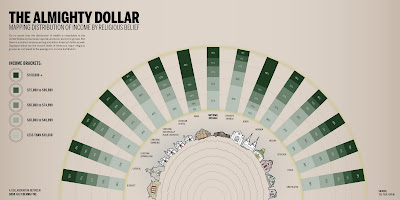
A recent study examines the breakdown of wealth in America by religion — and finds distinct variation between groups.


The article provides minimal analysis, but does raise a number of interesting questions, particularly the begging question of causation versus correlation. Jewish wealth is often traced back to the Middle Ages when people of all other faiths (well, Christian-derived faiths) were prohibited from entering the banking profession. Even if those historic roots are able to account for current wealth distribution, how can the other breakdowns be explained? Is it a reflection of the ties to race and ethnicity that religion have? Do different faiths place different values on work and leisure?

Second: Education. Studies point to the affirmative — YES, education does make us happier. (Comforting news to the college student currently in the library.) But, there is a growing consensus arguing a somewhat contrary position: that we are overeducating our children.

Though having a bachelor's degree may correlate to a certain level of happiness, is this really the best route for everyone? It's a viewpoint Americans are reluctant to express — we're supposed to be ever dreaming upward —but in other countries (Spain, for example), the "risk of overeducation" is a more widely expressed opinion. Because a college education does not necessarily guarantee a better occupation or lifestyle, students I met while studying abroad there put much more thought into whether or not to attend university. Comparatively, my friends and I stateside just viewed college as the automatic, the next step. Choosing not to go was never an option most of us considered. So although Brown is the happiest school in the country, are we actually happier because of the choice we made?

And if the quantifiable factors aren't satisfying for you, here's an article proving that happiness can be generated just by imagining how awful your life would be without the positive things you already have.

Wednesday, February 17, 2010

One man's recession is another's...

It is no secret that the United States economy dramatically affects world economic conditions. The American recession has sent ripples across the globe — from the meltdown on Wall Street to the declining value of the dollar to international unemployment. (Greece, anyone?)

But can the great American misfortune — the worst economic downturn since the Great Depression — actually be a positive force in some nations?

The success of China, as they grow at rates beyond those of any other nation and buy up American debt, is not a new story. The effective pause in economic growth on our side of the globe, though, gives a leg up to nations in need of catch up. In Vietnam, for example, where a decade of war (and subsequent decades of dependence) left a weakened economy and little independent infrastructure, parts of Saigon "might easily be in Orange County, California from the standpoint of large-scale retail, office and residential development."

At the World Economic Forum in January, it was the ministers from Vietnam and neighboring countries doling economic advice on rebuilding — an unlikely turn of events. The New York Times reported that American and European economic practices were not even discussed as role models. Instead, the mostly East Asian leaders explained their own tactics and reliance on consumerism.

The decline of American dominance in world markets as the United States battles through its recession has opened the door for nations to catch up, uninhibited. Prosperity may not solely be a question of policy or history, but also simply opportunity.

Tuesday, February 16, 2010

Culture Shock

When I first arrived for my semester abroad in Spain, it was hard to understand how anything ever got done in business. The Spanish people prize their siesta time, lunch is a three-hour affair (with wine, of course) and the night does not end until at least 2 am. Even when they are working, the Spanish have a much more laid-back attitude about, for example, task completion. They figure, why worry if it will get done eventually?

The adjustment is frustrating for American students who, three weeks into their classes, have not been formally matriculated, have no syllabus and do not know what materials are even needed for the course. The pervasive cultural attitude of work "as a necessary evil" creates an environment that values leisure and happiness at a level above productivity. (1) Relationships matter and often overpower the actual "work" side of working. In a tutorial for British nationals looking to work in Spain, the BBC cautions that individuals should "be prepared" for work to get personal. (2)

While work does matter to the Spaniards, it will never be the be-all end-all that it is for Americans. From the Spanish perspective, Americans will never be content with what they have. They, on the other hand, believe that by minimizing the pressures of work, they are able to better enjoy the simple pleasures in life, as well as the greater joys of culture and family. "Workaholism is not fashionable in Spain." (3)

In 2008, Spain's GDP per capita was $31,960, compared to the United State's $47,580. (4) But this does not explain everything. For example, the Spaniards enjoyed a longer life expectancy at birth (81 years versus 78). (5)

Given that the Spanish as a whole value leisure over work (the opposite being true in the United States), their GDP alone cannot give insight into the "wealth" of the nation. (6)

The fact that the Spanish have a generally weaker work ethic than Americans, and the reality of their culture offers an explanation as to why the GDP is lower (and why doing business with Spaniards is relatively difficult). Culture is a difficult variable to quantify, but it does offer some explanation for the numerical differences in material wealth between the United States and Spain.

But on the other hand: never discount the value of a mid-afternoon nap.
_____

(1) Weil, David. Economic Growth. Boston: Pearson Education Inc., 2009. pp. 410
(2) "Spanish for Work," BBC. http://www.bbc.co.uk/languages/spanish/forwork/beingthere/systems.shtml. Accessed on Feb. 16, 2010.
(3) Wattley-Ames, Helen. Spain is Different. Yarmouth, Maine: Intercultural Press Inc., 1992. Accessible on Google Books
(4) World Bank, www.worldbank.org. Accessed on Feb. 16, 2010
(5) Ibid.
(6) Weil 411
 
Copyright 2009 Pondering Prosperity
Convert By NewBloggerTemplates Wordpress by Wpthemesfree