Some say life is just a game. And then there is the game of Life.
 The 2000s era version has less explicit competition. It also no longer mandates insurance purchasing, stock options are fewer, job training has become minimal (occupations once came with "skills") and it is quite easy to sue your neighbor. Socioeconomic divides still exist, even if they are subtler.
A cursory glance at customer reviews of the game on Amazon.com — mostly from adults who played the game when they were children — reveals that some were less than pleased with the design overhaul.
"Money isn't the way it used to be."
"The old Life game was more true to life. The new game isn't."
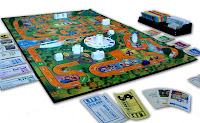
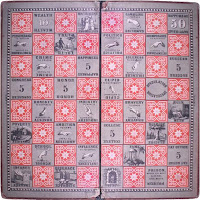
In 1860, Milton Bradley crafted the toy. It started at Infancy and ended in Happy Old Age. Along the way, you might find Happiness, but you also might find Ruin. The game was intended to teach its players a few moral lessons along the way too. The game enjoyed great popularity for years, before fading out of the public idea. A century later, Bradley's legacy — the toy giant — reintroduced the game. But not all was the same as it had once been. "Bradley’s game about vice, virtue, and the pursuit of happiness was reinvented as a lesson in Cold War consumerist conformity." (Sound familiar?)
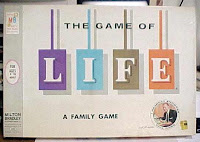
The 1960s version of the game — and the basic skeleton of the version today — has each player start in a little plastic car at the beginning of their life. The first choice you make is whether or not to go to college. In somewhat realistic fashion, the player who attends is saddled with debt; the player who skips ahead to the working world has fewer career opportunities. Earlier versions emphasized wealth collection. Jobs could be traded for better ones, stocks could be purchased, insurance was advisable. Sure, a certain degree was left to chance — but hey, that's life. The game ended when someone landed on the millionaire spot. Others could gamble for a chance to get there too, but the probability of becoming bankrupt was far more likely.
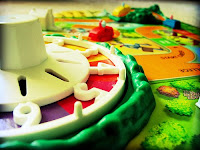
Throughout the last half-century, the game has been retooled again and again. The vicious zero-sum wealth-collection mentality of the board — though fun to competitive players — led to a change at Milton Bradley. Now, the game prizes public service — awarding bonus points for trash collection or technological innovation. House purchase (complete with mortgage and insurance) is still necessitated, but you can trade up if you're not happy. "Life tiles" allow for a chance comeback — the poorest player can still come out with a win at the end. The ending dichotomy, though slightly more subtle, still produces a socioeconomic split: You can live in Millionaire Estates or Countryside Acres. The former is classier, but riskier; the latter is less exclusive, but you take fewer chances in selecting it.
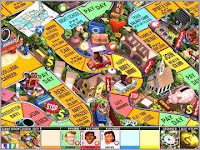
The 2000s era version has less explicit competition. It also no longer mandates insurance purchasing, stock options are fewer, job training has become minimal (occupations once came with "skills") and it is quite easy to sue your neighbor. Socioeconomic divides still exist, even if they are subtler. Is this an implied statement of what are lives have become? Is Milton Bradley trying to reflect how we live? Or is this merely a game meant to entertain children by the fireside? It's hard to claim that the moralistic undertones are entirely accidental. Even the small changes to the game are significant: the 60s convertible has become a clunky Chrysler minivan; the money has undergone serious inflation; the mortgage and home insurance card looks … different.
But on the other hand, the game is focused far less on wealth collection. Instead, there are arbitrary goals met on the way to becoming the so-called winner — a title that can be usurped if someone else happens to draw a better Life tile than you. So which was worse: the 60s version or the edition today? (*To note, many of these new changes have arisen even since the last time I played the game.)
"Like all earlier spiral race games, the Game of Life is essentially about fate, but it’s so relentlessly amoral and cash-conscious that a nineties redesign team, eager to make it less so, pretty much gave up. The new Twists & Turns game has no goal. In it, life is aimless," the New Yorker wrote, when reflecting upon the changes the game has undergone.
So why? What is the game reflecting? Does it reflect our lives and we just don't recognize it? Or has poor Milty gone off the map this time?
"Like all earlier spiral race games, the Game of Life is essentially about fate, but it’s so relentlessly amoral and cash-conscious that a nineties redesign team, eager to make it less so, pretty much gave up. The new Twists & Turns game has no goal. In it, life is aimless," the New Yorker wrote, when reflecting upon the changes the game has undergone.
So why? What is the game reflecting? Does it reflect our lives and we just don't recognize it? Or has poor Milty gone off the map this time?
A cursory glance at customer reviews of the game on Amazon.com — mostly from adults who played the game when they were children — reveals that some were less than pleased with the design overhaul.
"Money isn't the way it used to be."
"The old Life game was more true to life. The new game isn't."
"There isn't as much interaction between players in this one … not true to the real world as we know it."
"There are at LEAST 9 spots to land where you're supposed to sue your neighbor and get 100,000. I have a real problem with that. Another is where you get cosmetic surgery … what?"
One woman bought the game for her daughter and as astonished at the life she "lived": "The college option is a sham; next spin had her "Engaged"; subsequent move,"Baby Girl" (each player had to pay $5,000 dollars for a new baby). By the end of the game she had 7 children, a (heavily mortgaged) mobile home, NO job & had just landed on "Congrats, You are a Grandparent." A TERRIBLE GAME."
Some still saw the underlying moral values: "I realize this game was truly a product of the 50's. You had to get a job, had to get married and buy a house. Great family game."
Not all who played the game saw it as so negative. Many felt it taught their children about "real life" and as one agitated commenter wrote, "IT'S JUST A GAME!"

Game or not, the comments can be interpreted as a metaphoric reaction to the changes that have happened in our real lives. Our values have changed — no question. Bradley's intention back in 1860 was to create a game that linked "virtue and success," a game that understood the complex relationship between "chance and judgment."
The inherent issue with the Game of Life is that, although different paths are laid out, there is only one goal, one way to achieve success. There is a disregard for Milbrath's idea that "quality in living is experienced only be individuals and is necessarily subjective." (1) In the world of Life, "consumption becomes an end in itself" (though not quite as dramatically as Monopoly) and the interactions between players on the board is minimal. (2) The concern one player expressed about isolation can be seen in society at large — today, more than 50 years ago, we live introspective lives, despite growing globalization.
Milton Bradley may have attempted to shift the game away from a solely consumerist lifestyle with the introduction of public service and a greater role for Life cards, but no matter how the game is drawn and redrawn, you still need to make the big bucks to win the game.
Paul Krugman warns about the dangers of competitiveness, and the obsession with winning that can take hold. This is more explicitly present in the earlier version of Life: the in-it-to-win-it version, the zero-sum bankruptcy-or-bust model. Today's game has eliminated much of the "mindless competition" — but now you can sue the other players, you can pull off a surprise win based on luck — and so the competition becomes more personal, more subjective. (3)
The game cannot be taken too seriously — in a board game, there has to be a winner, and there's a limit as to how far personal choice can be taken. But the Game of Life can serve as a vantage point from which to view our own lives: we take on loans, with the promise of future payback; we buy insurance (or not) because the unknown scares us; we gamble our chances at comfort for a shot at top-tier living; we often get caught up in our own lives and own choices, forgetting to interact with those living or playing around us. We question the fairness and validity of a roll of the dice — and have no choice but to live with the consequences.
The competitive nature of living has become less black-and-white, maybe less zero-sum. Life has become more complicated in the last 100 — even the last 50 — years. So what can we do? We can spin the dial, hope it lands on our lottery numbers and make the best of what Life (and life) deal us.
____
(1) Milbrath, Lester. "Rethinking the good life in a sustainable society," Environmental Values. 1993.
(2) Sagoff, Mark. "Do we consume too much?" Atlantic Monthly. 1997.
(3) Krugman, Paul. "Competitiveness: A dangerous obsession."
(Related: The game gets a brief shout-out in R.E.M.'s "The Man on the Moon.")


