The 1998 film Pleasantville opens in a typical suburban high school with a montage of teachers speaking at their students.
...For those of you going on to college next year, the chance of finding a good job will actually decrease by the time you graduate. The available number of entry-level jobs will drop 31 percent over the next four years. Median income for those jobs will go down as well. Obviously, my friends, it's a competitive world, and good grades are your only ticket through. In fact, by the year 2000…
...The chance of contracting HIV from a non-monogamous lifestyle will climb to 1 in 150. The odds of dying in an auto accident are only 1 in twenty-five hundred. Now, this marks a drastic increase…
...from fourteen years ago, when ozone depletion was just at 10 percent of its current level. By the time you are thirty years old, average global temperature will have risen two and a half degrees, causing such catastrophic consequences as typhoons, floods, widespread drought, and famine...
...The chance of contracting HIV from a non-monogamous lifestyle will climb to 1 in 150. The odds of dying in an auto accident are only 1 in twenty-five hundred. Now, this marks a drastic increase…
...from fourteen years ago, when ozone depletion was just at 10 percent of its current level. By the time you are thirty years old, average global temperature will have risen two and a half degrees, causing such catastrophic consequences as typhoons, floods, widespread drought, and famine...
High school senior David is appalled at the world he lives in and longs for what he believes was a better, simpler time — the 1950s world depicted in his favorite television series. His twin sister is the embodiment of the MTV generation. Through a twisted (and obviously unrealistic) set of events, the two are catapulted into the archetypal 50s suburb: Pleasantville. David is thrilled, insistent that people "are happy like this." Jennifer could not disagree more — "nobody's happy in a poodle skirt and a sweater set."
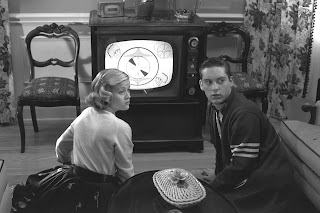
Throughout the course of the film, it becomes apparent that no one is quite as happy as the family dinners and school dances would lead the observer to believe. Stay-at-home mothers feel confined, occupational choices are limited, students barely question the material they are learning and no one has ever left the tiny little town they inhabit. Radical ideas begin to spread among the youth, prompting censorship and punishment. The town leader insists that it is necessary to "separate out the things that are pleasant from the things that are unpleasant," raising questions of discrimination and diversity of thought.
By the end of their journey, David's perfect vision of the 1950s has been shattered. He is forced to learn that "there is no 'right' life, no model for how things are 'supposed to be.' " (1) The good old days are not quite as "good" as they seemed. Though the people were able to live unhampered by technology and in tight-knit communities, they had their fair share of problems. Choices were more limited in terms of lifestyle, employment and even in what kind of thinking was permitted.
The movie was marketed to the very MTV generation it placed under the microscope, intended to serve as "a morality tale concerning the values of contemporary America by holding that social landscape up against both the Utopian and the dystopian visions of suburbia that emerged in the 1950s." (2)
David came away from his journey to Pleasantville disillusioned by the 1950s paradise, while Jennifer, the original skeptic, opted to stay in the past rather than return to her normal life. Though the movie does advocate some degree of nostalgia, it is "nostalgia leavened with a hint of danger or risk."
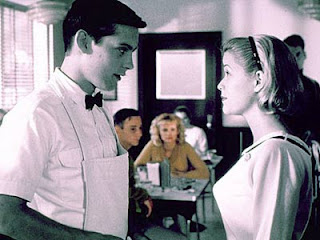
The take-away point of the nostalgia in Pleasantville is that one cannot make a value judgment as to who was happier: the teenager in the 1950s or the teenager in 1998. The differences are plentiful, but they span the gamut in both the positives and the negatives. Which is better (or worse): blatant discrimination and segregation or the stress and pressure of the college admissions process? Will innocent hours spent in the library or time passed on YouTube make us happier? Make us smarter? Make us more well off?
The movie's lesson is that even trying to make the comparison is imperfect. David envied the lifestyle of a Pleasantville teenager, but the Pleasantville teens had just as many complaints about their lives as he did. And with the experiences of a 90s kid, he could not appreciate all of the elements on Pleasantville — and quickly became disillusioned by the picture-perfect world.
Standard of living may have increased, health care may be better and information may be more acceptable, but it is impossible to state — objectively — if we are happier than we might have been in the 1950s (and vice versa). The best we can hope for is that we have learned from our mistakes — like the confinement of the Pleasantville social structure — and that we work toward improving the "unpleasant" aspects of life today. Like Billy Joel sang, "the good old days weren't always good and tomorrow ain't as bad as it seems."
_____
(1) McDaniel, Robb. "Pleasantville (Ross 1998)." Rev. of Pleasantville. Film and History May-June 2002: 85-86
(2) Beuka, Robert A. SuburbiaNation: Reading Suburban Landscape in Twentieth-Century American Fiction and Film. 1st ed. New York: Palgrave Macmillian, 2004. 14-15.